For good reason, ragi porridge is one of the most common first foods given to babies across India and parts of Africa. It’s gentle on a developing stomach, naturally gluten-free, and has one of the highest calcium contents of any grain. But the timing question still confuses many new parents. So, when can babies really start having ragi, and how do you introduce it the right way?
The answer is clear and based on evidence.
The Short Answer: Six Months
Ragi seeds can be introduced to babies from 6 months of age, along with the start of complementary feeding. This time lag is not unique to ragi. It follows broader advice from global health authorities on infant feeding.
According to the World Health Organization’s guideline on complementary feeding in 2023, infants should be introduced to complementary foods at 6 months (180 days) and continue to be breastfed. The guideline says it is a public health recommendation but notes there are some infants who may benefit from earlier introduction in specific circumstances determined by a paediatrician.
This window is also agreed upon by the American Academy of Paediatrics, which recommends the introduction of complementary foods at around six months. Ragi is one of the few grains that are suitable to be given as the first grain, along with other smooth, easily digestible cereals that fit in this timeline.
Why six months, and not sooner? Until this age, a baby’s digestive system is still developing, and breast milk or formula is sufficient to meet nutritional needs. The WHO guideline states that “exclusive breastfeeding for the first 6 months of life remains a foundational recommendation, with complementary foods introduced after this to fill nutritional gaps, especially for iron, zinc, and other micronutrients that milk alone cannot fully provide past this point.”
Why Ragi Is a Strong First Food Choice
Not all grains are the best first foods, but ragi does tick a few important boxes for early infant feeding.
High in Calcium for Bone Development
Data Source: National Institute of Nutrition, India (validated by USDA FoodData Central) Ragi Calcium Content per 100 g: Ragi has approximately 344 mg of calcium per 100 g. This is almost three times as much calcium by weight as is found in cow’s milk. For a baby, whose skeleton undergoes rapid development in the first two years, a calcium-rich first food directly supports that growth window.
Naturally Gluten-Free
Ragi is gluten-free, so it is a safe first grain for infants, even if there is a family history of gluten sensitivity or coeliac disease. Studies show that paediatricians often delay the introduction of gluten-containing cereals such as wheat, and most paediatric feeding guides recommend starting with non-gluten grains before introducing gluten-containing cereals.
Iron Content Supports an Important Nutritional Gap
Once a baby reaches six months, exclusive breastfeeding is not enough to meet iron needs, and iron is also flagged as a specific nutrient that complementary foods should help provide. Ragi has 3.9mg of iron per 100 grams and can be a good contributor to a baby’s total iron intake when supplemented with other iron-rich complementary foods.
Smooth, Easy-to-Digest Texture
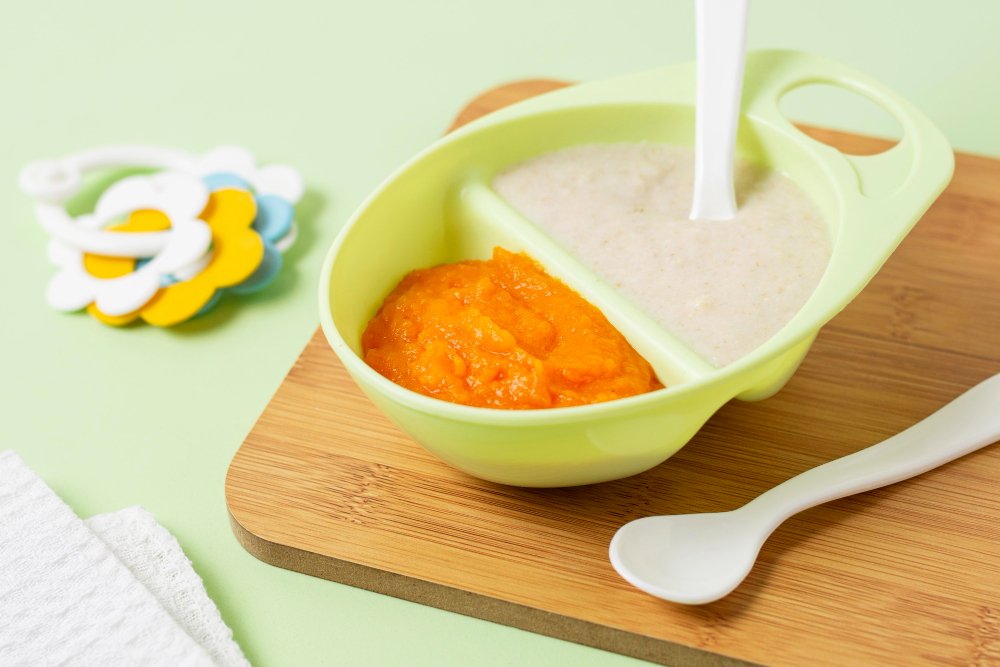
Ragi porridge is smooth and soft, perfect for a baby just starting solids, if properly cooked and well sieved. Its mild, slightly nutty flavour is generally well accepted by infants, and it can be mixed with breast milk, formula, or water to adjust consistency.
Low Glycemic Profile
Ragi releases energy slowly and does not give a sudden spike, which is good for steady energy levels between meals. This is key for a baby’s developing metabolism, which prefers a constant flow of nutrients rather than wild swings.
How to Introduce Ragi to Your Baby: Step by Step
Here’s a practical, age-appropriate way to introduce ragi.
Step 1: Choose the Right Form
Sprouted ragi flour is usually the best option to start with for babies under one year. Sprouting can help to reduce phytic acid, a natural compound that can interfere with mineral absorption, thus improving the availability of calcium and iron in ragi for a baby’s body.
Step 2: Prepare a Thin, Smooth Porridge
The first introduction should be thin porridge and have no lumps in it.
- In a bowl, add 1 tsp fine, sprouted ragi flour and add a little cool water and make a smooth paste without any lumps.
- Add this paste to a small pot with about 4 to 5 times the amount of water.
- Cook over low heat, stirring constantly, for 5 to 7 minutes or until slightly thickened and the raw smell goes away.
- Let cool to a safe lukewarm temperature before serving.
- If the consistency seems too thick for the first feeding, thin it out more with breast milk, formula, or water.
Step 3: Start Small and Observe
Day one: give just a teaspoon or two. Introduce another new food after 2 to 3 days, observing for any reaction. This is the usual way of introducing foods to infants, one at a time, so that you can identify which food is responsible for any allergic or digestive reaction.
Step 4: Gradually Increase Quantity and Thickness
If the baby can take to ragi well, then increase the amount to 2 to 3 spoons per serving over the next couple of weeks. As the baby gets more comfortable with solids, increase the thickness of the consistency gradually. Many babies can handle a thicker porridge by 8 to 9 months. Ragi can be mixed with mashed fruits like banana or with a little jaggery for natural sweetness.
Step 5: Expand Into Other Forms as Teeth and Chewing Develop
After 9 to 10 months, ragi can be given not just as a porridge but also as soft idlis, ragi-based khichdi, or mixed with other cereals as per the chewing ability of the baby and the paediatrician’s advice.
A Note on Allergenic Foods and Timing
Research on paediatrician feeding recommendations from peer-reviewed nutrition literature has demonstrated that the majority of paediatricians recommend starchy non-gluten grains, vegetables, fruit, and olive oil at 6 months, with gluten-containing grains generally introduced a little later, around 7 months. Ragi is gluten-free and belongs to the first group of first foods recommended by paediatric feeding guidance.
This does not mean that in most children ragi is an allergen. A true allergy to ragi is rare. As with all new foods, the usual precaution applies. Introduce it alone first, watch for reactions, and then begin mixing with other ingredients.
Signs Your Baby Is Ready for Ragi (or Any Solid Food)
Age is not the only criterion. The paediatric guidance generally suggests a combination of factors indicating developmental readiness.
- Can keep its head steady without support
- Can sit up with help
- Shows interest in food, for instance, by watching others eat or reaching for food
- Has lost the natural tongue-thrust reflex that pushes food back out of the mouth
- Can move food from the front of the mouth to the back for swallowing
If your baby is six months but hasn’t shown any of these signs yet, it’s worth talking to your paediatrician about timing rather than just throwing in solids on a set calendar date.
Common Mistakes to Avoid When Starting Ragi
Skip the sprouting or soaking step. Unsprouted ragi flour is plain and has a higher phytic acid content that can reduce the amount of calcium and iron that the baby actually absorbs. This is taken care of directly by sprouting or soaking before grinding.
Making the porridge thicker before you get time. The first solid food for a baby should be introduced in a thin, smooth form. “Gradual thickening over a few weeks happens as the baby develops the capacity to manage texture.
Salt or sugar is added during the first few months. Most paediatricians recommend avoiding the addition of salt to foods for babies under one year, as their kidneys are not yet prepared to handle it. Refined sugar sorghum vs pearl millet is not good for natural sweetness; it is better with mashed fruit or a little jaggery.
Adding several new foods at the same time. It’s difficult to find out the cause if ragi is combined with several other new ingredients in the same week a reaction happens. For the first few days, stick to single-food introductions.
Leftover porridge for another day. The ragi porridge, when freshly prepared, is best served hot and immediately. But if you keep it at room temperature for long hours, it can cause bacterial growth, which is a problem for any baby food, including ragi.
What If My Baby Doesn’t Like Ragi at First?
This is normal and nothing to worry about. For babies, it can take 8 to 10 tries before they accept a new flavour or texture; they often need multiple exposures. If your baby does not like ragi the first time, try again after a few days instead of abandoning it and finger millet or pearl millet is better. You can also make the switch easier by combining it with a small amount of breast milk or a familiar mashed fruit.
Sourcing Quality Ragi for Baby Food
Babies eat little food, and their immune systems are still growing, so the quality and freshness of the ragi flour used are even more important than they would be for adult cooking.
Here are signs of quality when buying ragi for making baby food:
- Smell: Clean, slightly nutty. No mustiness or sourness.
- Uniform colour of the grain, usually dark reddish brown for whole ragi.
- Clear labelling of the product is required, as this affects preparation and nutrient availability.
- Airtight packaging with visible milling/packing date
Ragi (Finger Millet) – Ragi is one of the grains and millets that CMS Industries sources and exports from India. For baby food makers and bulk ingredient buyers who require consistent quality and documentation with every order, teaming up with a dedicated agricultural exporter can provide a level of traceability that loose retail sourcing generally can’t.
Frequently Asked Questions
- Can I give ragi to my baby before 6 months?
No. The World Health Organization recommends exclusive breastfeeding for the first six months and the introduction of complementary foods, including ragi, only after this period. You want to wait until the recommended time to start solids unless there is a medical reason to start early and your paediatrician recommends it.
- How much ragi porridge should I give my 6-month-old baby?
Start with 1 to 2 teaspoons on the first day to see how well you tolerate it. If your baby has no adverse event for the next few days, you can gradually increase to 2 to 3 tablespoons per serving over the coming weeks, depending on your baby’s appetite and your paediatrician’s advice.
- Is sprouted ragi better than regular ragi flour for babies?
Yes, usually. Sprouting decreases phytic acid, a compound that inhibits the absorption of iron and calcium. This makes it easier for a baby’s body to absorb the nutrients in ragi. This is especially useful during the early months when the efficiency of nutrient absorption is most important for growth and development.
- Can ragi cause allergies in babies?
Ragi allergies are very rare but possible, as with any new food you introduce. Introduce ragi alone for a few days and watch for symptoms like rash, unusual fussiness, vomiting, or digestive upset. If you notice any reaction, stop feeding ragi and consult your paediatrician before feeding it again.
- What is the best first preparation of ragi for a baby?
The usual initial preparation is a thin, smooth porridge made of sprouted ragi flour, cooked with additional water to a lump-free consistency. It can be watered down more with breast milk or formula to make the texture more familiar and easier for a baby to take in the first few feedings.