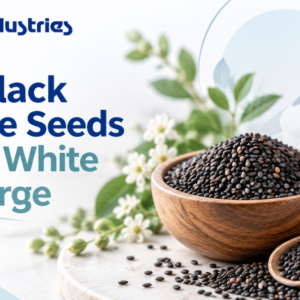

Open two packets of sesame seeds. One has jet-black seeds that you can hear crunching. The other has pale, creamy seeds that are soft to the touch and look almost bland. Both are sesame, but they act differently in your kitchen and in your body.
Let’s unpack that. CMS Industries is an agro commodity exporter based out of Kachchh, Gujarat. They have both black sesame seeds and hulled sesame seeds in their oilseed range. Here are facts side by side. This guide is derived from nutrition data and published sources. Only for informational purposes and is not medical advice.
Quick Answer: Hulled vs Unhulled Black Sesame Seeds
Unhulled seeds have their outer coat intact. Hulled seeds are no longer. That one step changes colour, taste, texture, and mineral content. Here’s the quick version:
- Unhulled black sesame: Dark coat intact, crunchy, slightly bitter, much higher in calcium and iron. Higher in oxalates.
- Hulled sesame: Skin off, pale and smooth, milder and softer, higher in oil, and much lower in calcium.
- The colour black: It lives in the coat. The black sesame that is sold as black is unhulled; when a black seed is hulled it has the layer that makes it black is removed.
Now let’s see what hulling actually does.
What Does Hulled Mean in Sesame Seeds?
The hull is the external coating of the seed, also called hull or skin. Natural or whole sesame is unhalved sesame, which preserves it. Hulled Sesame / Shelled Sesame: Sesame with hulls removed.
Mechanical vs Chemical Hulling
Processors use two techniques. Mechanical hulling removes the coat by friction or by attrition. Chemical hulling involves soaking the seed in a solution of sodium hydroxide (lye) to dissolve the coat and then rinsing well. One procurement guide tells buyers to check the method with their supplier, as the method can affect whether a product can carry a natural label.
Why Hulled Black Sesame Loses Its Colour
The black sesame is naturally dark because of the dark seed coat. Peel the coat off, and you have a pale kernel. Hulled seeds are off-white and turn brown when roasted. Therefore, if a bag promises black seeds and also says hulled, ask the vendor exactly what he has inside.
Appearance, Taste, and Texture Compared
| Feature | Unhulled black sesame | Hulled sesame |
| Colour | Black to very dark | Off-white to cream, with browns when roasted |
| Flavour | Stronger, slightly bitter | Mild and nutty |
| Texture | Crunchy | Soft and smooth |
| Common uses | Asian cuisines, health foods, sesame oil | Tahini, halva, bakery toppings, food service |
| Storage | Stays stable in a cool, dark place | Does better in cold storage |
The taste difference is real. Dehulled seeds were perceived as softer and milder, and unhulled as crunchier and more flavourful. This means you can substitute one for the other, but you will notice the difference in your dish.
Nutrition: Hulled vs Unhulled Black Sesame Seeds Compared
The USDA lists hulled (decorticated) sesame kernels separately from whole dried sesame seeds. The entries are for sesame in general, not just for black sesame. Black sesame is sold with its coat, unhulled, and the whole-seed column is a fair guide. The figures per 100 grams are as follows:
| Nutrient (per 100 g) | Whole (unhulled) | Hulled kernels |
| Calories | 573 | 631 |
| Protein | 17.7 g | 20 g |
| Fat | 49.7 g | 61 g |
| Calcium | 975 mg | 60 mg |
| Iron | 14.6 mg | 6.4 mg |
| Magnesium | 350 mg | 345 mg |
Here’s how to read that table. Hulled kernels have more calories, protein, and fat per 100 grams because you are eating more kernel and less coat. The coat is laden with iron and calcium. As soon as the hull is gone, calcium drops from 975 mg to 60 mg. Magnesium hardly moves. Healthline also says most of the calcium is in the hull. For more information, see this guide on black sesame seeds.
Is the Calcium in the Hull Fully Usable?
That 975 mg figure looks impressive, but check out the fine print. One source of nutrition says that most of the calcium in the hull is calcium oxalate. The body does not absorb that form as easily as it does the calcium of hulled seeds. So the number on paper is more than what you get in.
Hulling and roasting do make a difference too. Healthline says both steps cut down on oxalates and phytates, compounds that get in the way of digesting protein. One study found that sprouting cut phytate and oxalate by about half in both hulled and unhulled seeds. If you want a more convenient source of protein, opt for the hulled and roasted seeds. Unhulled seeds win if you want more minerals on paper.
The bottom line: No one type is better for everyone. Your goal determines it.
Oxalates and Kidney Stones: Who Should Be Careful
Oxalate is a naturally occurring plant compound. In some people, oxalate in the urine combines with calcium to form kidney stones. Calcium oxalate is the most common type of stone.
A consumer health resource lists tahini and sesame seeds as among the moderately high oxalate foods. It also states that people with no history of kidney stones do not need a low-oxalate diet. The US National Institutes of Health’s NIDDK recommends that people who have had calcium oxalate stones reduce certain high-oxalate foods. It adds that calcium itself does not cause calcium stones and suggests talking to a health professional about how much calcium to eat. A 2019 review in the American Journal of Physiology (Renal Physiology) suggests that patients prone to stone formation should drink plenty of fluids, avoid oxalate-rich foods, and eat sufficient calcium.
Which One Should You Choose?
- Hulling reduces oxalate but does not remove it.
- Talk to your doctor before you make unhulled black sesame a daily habit if you have a history of stones.
- Which should you pick?
Choose hulled sesame when:
You want crunch, colour and a stronger flavour in til laddoo, chikki, chutney or as a garnish.
- You want more calcium and iron in your seed.
- You have never had kidney stones.
- When to harvest hulled sesame:
- Hulled seeds are the norm for making tahini, halva, or smooth pastes.
- In baking, you want a mild flavour and a soft texture.
- Your doctor has recommended oxalate restriction.
Lightly toast either kind before using. Roasting reduces oxalates and phytates and improves the nutty flavour.
How to Store Hulled and Unhulled Sesame Seeds
Unhulled seeds can be stored for long periods at room temperature. Hulled seeds have more oil exposed and do better in cold storage. For Both Types: Store in an airtight jar in a cool, dark place. Smell the seeds before you cook. Fresh sesame smells like nuts. If the oil smells sharp or stale, it has gone bad.
How to Buy Sesame Seeds: A Short Checklist
- Look at the label. Watch for words like unhulled, natural, or whole on one side and hulled on the other.
- Ask about the hulling process. For hulled seeds, find out if the supplier used mechanical or lye hulling.
- Check on cleanliness. Seek out even seeds, without stones, bits of husk, and dust. CMS Industries says it cleans its black sesame seeds with Sortex and machine cleaning technology and packs in 15, 25, 40 and 50 kg sizes in PP, BOPP or jute bags. Its oilseed range includes hulled, black, natural, roasted, brown, white, and double-skin red natural sesame.
- Use your nose. Pick out seeds that smell clean and nutty.
- Read labels for allergens. Packaged products that contain sesame must state that fact.
Sesame Allergy: Hulled or Not, It Still Counts
Hulling does not make sesame into a different food. USDA lists sesame as the allergen for both whole seed and hulled kernels. In the US, sesame became the ninth major food allergen under the FASTER Act, and labelling rules went into effect in January 2023.
Symptoms of sesame allergy include hives, welts, itching, coughing, difficulty breathing, vomiting and diarrhoea. Stop eating sesame and get emergency medical help if you have swelling, wheezing or trouble breathing after eating sesame.
Final Word
Let us finish. And the hull is the whole story. Eat it, and you get the colour black, the crunch, a bolder taste, and far more calcium and iron, plus more oxalate. Take it off, and it’s a mild, soft, pale seed that’s good for tahini and baking. Neither is wrong.
Next steps: decide what you are cooking, check your health history, read the label, and store the seeds properly. If you’ve had kidney stones, check with your health care provider first.
Frequently Asked Questions
Are hulled or unhulled black sesame seeds healthier?
Neither outright wins. In theory, unhulled seeds have much more calcium and iron but also much more oxalate. Hulled seeds have a milder flavour and lower oxalate. Choose according to your health needs, your taste and any history of kidney stones.
Is black sesame hulled or unhulled?
Black sesame sold as black is unhulled; the dark colour is in the seed coat. The hulling takes off this coat and leaves a pale kernel. If the pack of black seeds is labelled hulled, check with the seller.
Does hulling reduce oxalates?
Sure. Healthline says hulling and roasting both reduce oxalates and phytates, and sprouting reduced them by about half in one study. Lower isn’t zero, so if someone has had a stone, they should still see a doctor.
Which has more calcium, hulled or unhulled sesame?
Unhoused. USDA data shows whole seeds vs. hulled kernels with about 975 mg per 100 grams vs. 60 mg. Much of that calcium is bound to oxalate, so your body absorbs less than the number.
Can I swap hulled seeds for unhulled in recipes?
Yes, but times will change. Unhulled seeds are crunchier and have a stronger taste, while hulled seeds are softer and have a milder taste. Black seeds will colour your dish too. Make a small batch and tweak to your liking.