
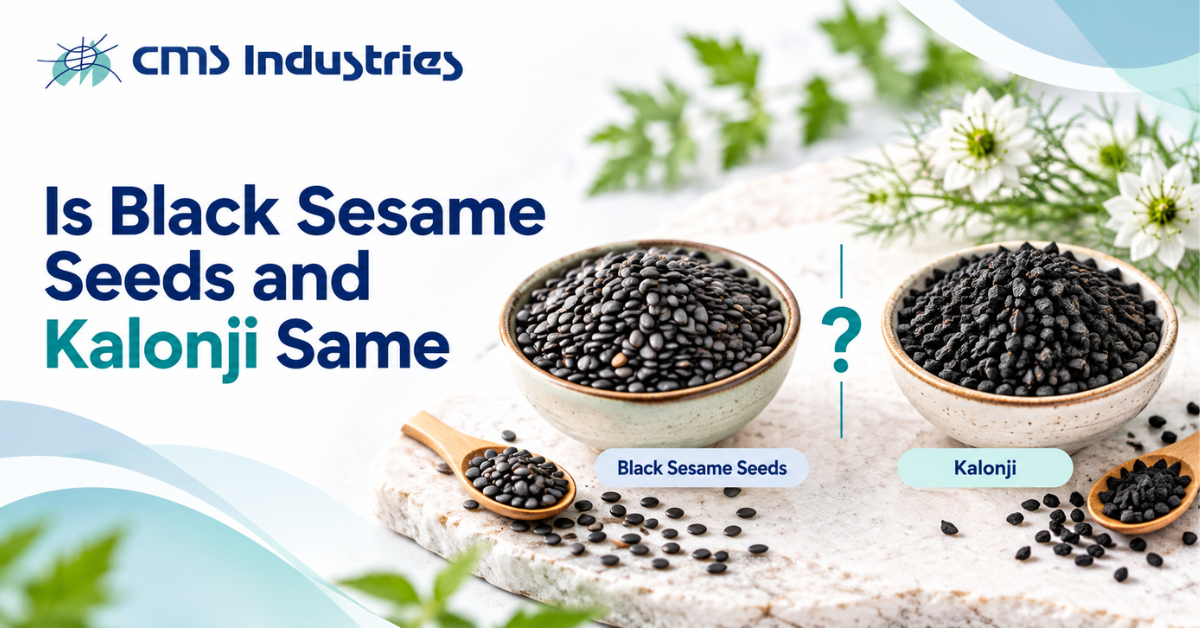
In almost any Indian kitchen, if you open a spice box, you will find two tiny black seeds that look alike. One is Kala Til. The other is black seed. They sit next to each other, shops muddle up their names, and there are plenty of recipes that use the words interchangeably.
So are they the same thing? Briefly, the answer is no. Let’s break them down with some botany, nutrition facts, and a few buying checks, so you can tell them apart before you cook, buy, or gift.
Quick Answer: Are Black Sesame Seeds and Kalonji the Same?
Are black sesame seeds and kalonji the same? No. Black sesame (Sesamum indicum) and kalonji (Nigella sativa) are from two different plant families, taste different, and do different jobs in the kitchen. Only the colour is the same.
Short version:
- Family of plants: sesame belongs to the Pedaliaceae family. Kalonji is a member of the buttercup family, Ranunculaceae.
- Size and shape: Black sesame seeds are flat and pear-shaped, about 3 mm. The seeds of kalonji are angular, three-sided, and are 1 to 2 mm in size.
- Taste: sesame has a nutty flavour. Kalonji has a peppery, bitter flavour with a touch of onion.
- Common use: sesame is used in chikki, laddoos, and tahini. Kalonji is used in naan, pickles, and panch phoran.
Why So Many People Mix Them Up
Colour and size cause the first mistake.
Both seeds are black, small, and sold in identical packets. According to Cook’s Illustrated, nigella goes by many names, including black sesame, black cumin, black caraway, and onion seed. Most of the confusion is caused by that stack of labels.
The naming trap: onion seed, black cumin and kala jeera
Three names are the cause of most mistaken purchases:
- Onion seed Kalonji is not related to onions. Cook’s Illustrated does describe the seeds as adding a herby, oniony flavour, but the label is a market habit, not botany.
- Black cumin. The drug.com website lists black cumin as a common name for Nigella sativa. But Bunium persicum, also sold as black cumin, is a different spice. It comes from the parsley family (Apiaceae) and is grown in the mountains of Kashmir.
- Kala jeera. Gernot Katzer’s Spice Pages notes that this name sometimes falls on nigella, though it is an unrelated spice.
The same tangle appears in product listings. Black Sesame Seeds – Oil Seeds. Kalonji / Onion Seeds – Spices. Black Cumin Seeds – Spices. CMS Industries, Kachchh, Gujarat – Agricultural Exporter. The page on black cumin does not provide a botanical name. In many listings, only common names are used, so always ask the supplier for the Latin name.
Two Different Plants: The Botany
| Feature | Black sesame | Kalonji |
| Botanical name | Sesamum indicum | Nigella sativa |
| Plant family | Pedaliaceae | Ranunculaceae (buttercup family) |
| Plant | Annual herb grown for oil-rich seeds | Annual plant, 30 to 60 cm tall, with grey-blue flowers |
| Seed size | About 3 mm | 1 to 2 mm |
| Seed shape | Flattened, pear-shaped | Three-sided, angular |
| Other names | Til, kala til, benne | Kalonji, black seed, nigella |
The Cambridge World History of Food lists sesame as a member of the Pedaliaceae, a small family of about 15 genera and 60 species, and its seeds are about 3 mm long. The cultivated sesame plant is native to India, Bangladesh, and the western Himalaya, according to Singapore’s National Parks Board. For more information, see black sesame seeds and calcium. According to Drugs.com, kalonji is an entirely different plant that has grey-blue flowers and a toothed pod that contains three-sided, tiny black seeds.
Different family = different chemistry. That’s why the two seeds smell, taste, and behave so differently once they get to a hot pan.
How to Tell Them Apart at Home
Next steps for a quick kitchen test:
- Check Size. The sesame seeds are much larger. Kalonji seeds are 1 to 2 mm, about half or a third the width of a sesame seed.
- Verify the shape. Sesame seeds are flat and teardrop-shaped. Kalonji seeds are angular and three-sided in shape.
- Crush some seeds. The smell of sesame is light and nutty. Kalonji has a sharp, peppery, and slightly onion-like smell.
- “Just try one seed. Kalonji has a bitter aftertaste. Cook’s Illustrated says bitterness is the reason cooks almost always leave the seeds whole, because grinding makes it stronger.
- Read the label. You will find Sesamum indicum on sesame and Nigella sativa on kalonji.
Nutrition Side by Side
Whole, dried sesame seeds are listed on the USDA website at 573 kcal/100 g, with approximately 50 g of fat, 17.7 g of protein, and 975 mg of calcium. According to Drugs.com, kalonji seeds are approximately 21% protein, 35% carbohydrate, and 36% fat.
| Per 100 g | Sesame, whole and dried (USDA) | Kalonji (Drugs.com) |
| Fat | About 50 g | About 36% by weight |
| Protein | About 17.7 g | About 21% by weight |
| Carbohydrat e | About 23.5 g | About 35% by weight |
| Calcium | 975 mg | Present, no figure given |
| Energy | 573 kcal | Not given |
The figures are from various sources and techniques, so take them as a broad picture, not a contest. What matters is the serving size. Most people eat sesame by the spoonful in laddoos or chutneys and kalonji by the pinch. A standard serving of kalonji is a lot less of everything, including calories and minerals.
Plant compounds: lignans versus thymoquinone
Sesame contains lignans such as sesamin, sesamolin, and sesamol, which are the main compounds identified in a 2026 study in Agro Productividad. Kalonji is the seed of the Nigella sativa plant, a member of the buttercup family, and its headline compound is thymoquinone, which Drugs.com says is roughly 28% to 57% of the seed’s volatile oil.
Here’s why you should be wary before reading the kalonji claims. The oil, extracts, or animal models are used in many studies. ‘No clinical data is available for dose setting, and additional human studies are needed,’ said Drugs.com. Sesame has a more defined role as a food of everyday use because of its calcium, protein and fibre.
Taste and Aroma: What Your Tongue Will Tell You
The quickest way to tell the two apart is by taste. Black sesame has a mild, nutty, slightly earthy flavour, and toasting deepens it. It is a background note that pairs well with both sweet and savoury dishes.
More loudly, Kalonji Cook’s Illustrated describes piney, menthol-like notes with a bitter undertone, and cooks often pair it with fenugreek, cumin, mustard and fennel in panch phoran. A pinch in hot oil gives off a sharp, peppery smell in seconds. That aroma is why kalonji is used in tempering for dal and vegetables, but sesame rarely is.
Heat treats the two differently too. Light Toasted Sesame: If kalonji burns, it becomes bitter, so keep the pan on medium heat and pull it off quickly.
How Cooks Use Each Seed
Black sesame:
- Lightly toast and fold into til laddoos, chikki and chutneys
- Sprinkle over rice, rotis and salads.
- Grind into sesame butter or tahini
Kalonji:
- Scatter on naan before baking, as is done in many Indian kitchens
- Add to pickles and vegetable dishes, especially potatoes.
- An ingredient in panch phoran, the five-spice mix of eastern India.
Cook’s Illustrated also recommends sprinkling kalonji on salads, fish and lentils. Keep the seeds intact for flavour.
Can You Swap One for the Other?
Not for flavour. Kalonji will flatten a nutty dish, and sesame will dull a peppery pickle. You can use black sesame as a visual substitute for it on top of bread, as both look dark on a pale crust. Don’t expect the same kind of flavour.
Which Seed Should You Pick?
Match the seed to the job you have at hand:
- Black sesame is for you if you want a nutty laddoo, chikki, or tahini.
- Naan: If you like pickles or a bold tempering, go for kalonji.
- For a calcium-rich spoonful: choose sesame, which the USDA lists as 975 mg per 100 g for whole seeds. Kalonji is a spice, so it won’t affect your calcium intake much.
- If you want a dark garnish that is not highly flavoured, use black sesame.
- If you see a recipe calling for “black cumin” or “onion seed”, you should first check the recipe’s origin and then see if it means Nigella sativa or kala jeera.
Many kitchens have both. They are inexpensive, have a long shelf life in airtight jars stored away from heat and light, and fill a niche that the other cannot.
Safety Notes Worth Knowing
- Allergy to sesame. Sesame is an allergen known for foods. If you have a sesame allergy, you should stay away from it.
- Kalonji oil for the skin. Drugs.com lists a very low rate of side effects but does list two case reports of allergic contact dermatitis from kalonji oil used on the skin.
- Pregnancy and Lactation. Drugs.com states that there is not enough safety data on kalonji during pregnancy and breastfeeding. Consult a physician before using in excess of culinary amounts.
- Medical use. Neither seed replaces therapy. If you are pregnant, nursing, or have any health condition, consult your health care professional before using either of these products.
Buying Tips for Home Cooks and Bulk Buyers
- Read the plant name. Sesame: Sesamum indicum. Kalonji is Nigella sativa. The third spice is bournium persicum, kala jeera.
- Enquire about hulling. Black sesame often retains its coat. Hulled sesame is a lighter colour and has different minerals.
- Check the mark. Uniform colour and size, clean seed, and no stones or husk.
- Request Spec Sheet. Ask for moisture, purity, and, if you are interested in the mineral content, a lab report.
- Check pack sizes. CMS Industries’ black sesame, kalonji, and black cumin pages all mention sortex and machine cleaning and 15, 25, 40, and 50 kg packs in PP, BOPP, or jute bags with custom printing. Get it in writing and take that as a baseline.
Three Quick Myths
Myth 1: Kalonji is a type of black sesame.
It isn’t. Sesame is from Pedaliaceae, and kalonji is from Ranunculaceae. Their only common feature is a dark seed coat.
Myth 2: Kalonji comes from onions.
It doesn’t. True onion seeds are from the onion plant, and kalonji is from Nigella sativa. It’s a trade habit, the name.
Myth 3: Black cumin always means kalonji.
Not all the time. In India, black cumin can mean either kalonji or kala jeera from Kashmir, so check the Latin name.
The Bottom Line
Is black sesame seed the same as kalonji? Colour only. They vary in plant family, size, taste, role in the kitchen, and compounds they contain. For nutty richness and calcium-rich bulk, go for black sesame. For a bitter, peppery accent, use kalonji. If you buy either of these, read the botanical name first.
Frequently Asked Questions
Is kalonji the same as black sesame?
No. Kalonji is Nigella sativa, a buttercup-family plant with tiny angular seeds and a peppery, bitter flavour. Black sesame is a different family, Sesamum indicum, with larger, flat seeds and a nutty flavour.
Is kalonji the same as onion seeds or black cumin?
Kalonji is frequently sold as onion seeds, but it is not an onion product. It is also sometimes referred to as black cumin, though that name can also refer to kala jeera, another Kashmiri spice. Look at the Latin name on the label.
Can I use black sesame instead of kalonji in naan or pickles?
You can use it for looks but not for taste. Black sesame lends a mild nutty taste, and kalonji a sharp peppery bitterness. Pickles and breads that depend on that bite will taste different.
Which is better for health, black sesame or kalonji?
Neither wins outright. A spoonful of sesame seeds gives you calcium, protein, and fibre. Kalonji contains thymoquinone, but strong human evidence is limited. Eat as food and see your doctor before using either for a health condition.
How can I tell black sesame from kalonji at home?
Compare smell, size, and shape. Sesame seeds are flat, nutty, and around 3 mm. The seeds of Kalonji are angular and three-sided, 1 to 2 mm in size, and have a strong peppery smell when crushed. The label should have the Latin name.